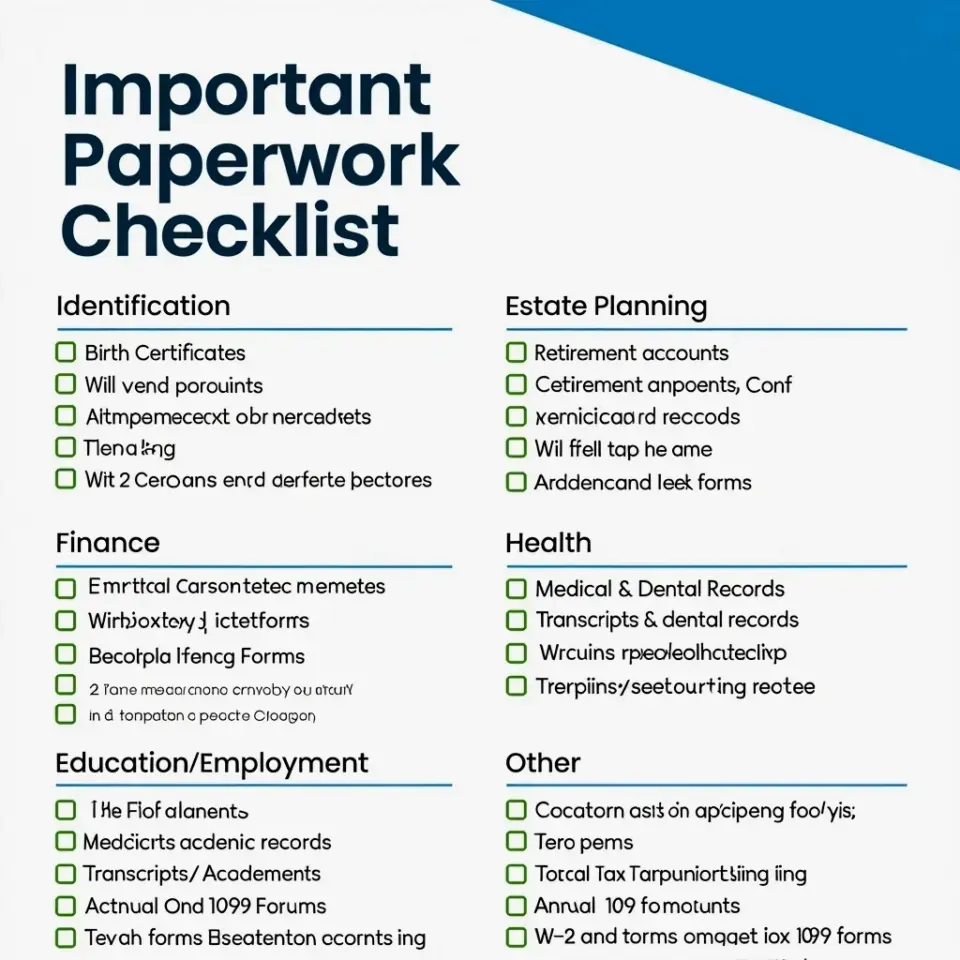
I used to think home organization meant alphabetizing my spice rack. Nope. The real disaster was hiding in a filing cabinet I was too scared to open. Piles of random documents, expired insurance cards, a birth certificate I hadn’t seen in years. Honestly, it was embarrassing. Then I found one simple tool that changed everything: the important paperwork checklist. This blue-and-white printable broke every category down for me, ID, estate planning, finance, health, education, and other. Nothing got missed. If you’re tackling home organization systems, this is a great starting point. Grab it and see the difference. 🗂️
Identification: The Starting Point for Any Home Organization System
Ok so, the first section of my checklist was labeled “Identification.” It had green bullet points for things like your passport, Social Security card, driver’s license. Honestly, I had duplicates of some and zero of others. Finding my original birth certificate took two hours of digging through an old shoebox from my mom’s basement. Not gonna lie, I cried a little. But once I had it in a labeled folder? Immediate relief.
The checklist also reminded me to note the issuing date and expiration for each document. That little detail saved me last month when I renewed my passport. I just looked at my sheet, saw the expiration, and dealt with it before the travel panic. Home organization starts here because if you can’t prove who you are, you can’t do much else.
Tackling Estate Planning While You Still Have the Energy
Let’s talk about the section nobody wants to open: estate planning. The checklist’s blue header for this part had items like wills, trusts, power of attorney, and living wills. I’ll be honest, I had zero of these. For years I told myself I was too young. Then a friend my age had a sudden health scare, and I realized “young” is not a legal document.
So I made a will. It took an afternoon and a notary. The checklist guided me to also think about who holds the original copy. I keep it in a fireproof envelope. Two words: life insurance. That one bullet point forced me to call my HR and actually understand my policy. The checklist didn’t just list documents, it asked for the location and contact info for each. That level of detail is what makes this a real home organization tool, not just a to-do list.
Getting Your Finances in Order Without the Panic
The finance section on my checklist is the longest. Under that green bullet point list were things like bank account statements (last 12 months), tax returns (last 7 years), investment records, and loan documents. Look, I’m not a spreadsheet person. My natural instinct is to shove receipts into a drawer and hope for the best. But this checklist forced me to sort by year and then by type. And you know what? It took less than an hour for the whole pile.
- Bank account numbers and branch info
- Credit card statements (just the yearly summaries, not every monthly bill)
- Retirement account beneficiaries, I hadn’t updated mine in five years, whoops
- Debt records: mortgage, car loan, student loans (the ones I still owe)
See that last one? I’d been ignoring my student loan balance for months because it stressed me out. Seeing it on paper, in my binder, actually made me call the servicer and set up an autopay. Sometimes home organization is also emotional organization. The checklist didn’t judge me for having debt, it just told me where to file the paperwork.
Health Documents You Never Knew You Needed to Save
Health section. Honestly, I thought this would be quick. Vaccination records, insurance cards, maybe a list of medications. But the checklist included things like advance directives and medical history summaries. Here’s a weird detail: I found an old allergy test result from 2012 that showed I was allergic to something I’d been eating regularly. The test said “moderate reactivity to almonds.” I eat almonds every day. Maybe the test was wrong, but now I have the record if I need it.
The checklist also had a spot for your primary care doctor’s contact info and pharmacy details. I used to keep that in my phone, but phones die. A physical folder never loses battery. I even added a note about a weird mole I’m watching, I scanned the dermatologist’s note and filed it. Overkill? Maybe. But when the doctor asks “when did you first notice this?” you’ll have the answer.
Education and Employment Records – Don’t Toss That Transcript Yet
This section surprised me. I thought I only needed diplomas and maybe a resume from my last job. The checklist listed transcripts, professional certifications, training certificates, performance reviews, and even letters of recommendation. I almost skipped it. But then I remembered I needed a copy of my college transcript for a job application two years ago, and I had to pay $15 to rush it from the registrar. If I had kept it in my home organization system, I’d have saved money and time.
So I made a folder for each job I’ve held in the last 10 years. Inside: offer letter, exit paperwork, and one standout performance review where my boss said I was “unusually persistent.” I have no idea what that means but it makes me smile. The green bullet points on the checklist also reminded me to include military records if applicable. I don’t have any, but my dad does, so I forwarded the checklist to him too. See? That piece of paper is spreading organization beyond my own home.
The “Other” Category – Where the Surprises Hide
Last section on the checklist: “Other.” It felt like a catch-all at first. Pet records? Vehicle titles? Home warranty? Safe deposit box inventory? I had to think outside the typical filing system. Here’s what I found: I had an old gym membership contract that I swore I canceled. Turns out it was still auto-drafting $39 a month. For three years. That was a painful call to the bank, but at least I had the contract number from my checklist notes.
I also added a small sub-list of things that weren’t on the original checklist but made sense for my life: digital asset passwords, a list of subscriptions, and the serial numbers for my laptop and bike. The beauty of a printed checklist is you can write in the margins. My copy has coffee stains and scribbles in the “Other” box. It’s not pretty, but it’s mine. And it works.
Before this checklist, my home organization was a mess of good intentions and overflowing drawers. After? I have one binder, six tabbed sections, and the peace of mind that comes from knowing where everything lives. It didn’t take a full weekend. It took a couple of evenings and a willingness to face the pile. If you want to start, grab the checklist I mentioned, it’s literally a one-page PDF. Print it. Start with the top section. You’ll feel the weight lift.
#importantpaperworkchecklist #homeorganization #paperworkorganization #documentchecklist #organizationtips
Leave a Comment